|
 
General information:
 Non-spore-forming, Gram-negative bacilli, a member of the γ-proteobacteria, and so far, 42 species and 65 serogroups of Legionellae have been described. Non-spore-forming, Gram-negative bacilli, a member of the γ-proteobacteria, and so far, 42 species and 65 serogroups of Legionellae have been described.
Intracellular replication within selected host cells is the primary and perhaps sole means of proliferation in the environment.
Many of these species are reported to be pathogenic for humans, but L. pneumophila is the most frequently isolated species associated with disease.
Characteristics:
Dual host system
allowing intrcellular growth in protozoa, such as Acanthamoeba castellanii, Hartmanella sp. or Naeglaria sp., and in human alveolar macrophages. Protozoa are essential for the growth of Legionella and the interaction with amoeba seems to generate a pool of virulence traits during evolution.
Intracellular pathogen
invades and replicates within a protective phagosome inside alveolar macrophages.
Two phase of growth
replicative phase -- sodium resistance, non-flagellated, low cytotoxicity
infectious phase -- short, thick, flagellated and highly cytoxicity.
Killing and lysis of macrophages require two steps
trigger apoptosis at early stage
induce pore formation later.
The key to L. pneumophila's virulence is its ability to prevent phagosome-lysosome fusion.
The genome sequences of L. pneumophila contains a large number of genes encoding proteins that show high similarity to eukaryotic proteins or motifs known to be involved in protein-protein interactions, which are present either solely or primarily in eukaryotes, suggesting that L. pneumophila may have acquired specific mechanisms of cross-talk with its eukaryotic hosts.
A particularly high number and wide variety of secretion systems presented in L. pneumophila genome.
Disease:
Legionnaires' Disease.
Selected genomes: ⇒ comparative pathogenomics ⇐
L. longbeachae NSW150, 4077332 bp, NC_013861
L. pneumophila str. Corby, 3576470 bp, NC_009494
L. pneumophila str. Lens, 3345687 bp, NC_006369
L. pneumophila str. Paris, 3503610 bp, NC_006368
L. pneumophila subsp. pneumophila str. Philadelphia 1, 3397754 bp, NC_002942
Genome-related publications:
 Chien M, et al., 2004. The genomic sequence of the accidental pathogen Legionella pneumophila. Science 305(5692):1966-1968. Chien M, et al., 2004. The genomic sequence of the accidental pathogen Legionella pneumophila. Science 305(5692):1966-1968.
Cazalet C, et al., 2004. Evidence in the Legionella pneumophila genome for exploitation of host cell functions and high genome plasticity. Nat. Genet. 36(11):1165-1173.
Glockner G, et al., 2008. Identification and characterization of a new conjugation/type IVA secretion system (trb/tra) of Legionella pneumophila Corby localized on two mobile genomic islands. Int J Med Microbiol 298(5):411-428.
Cazalet C, et al., 2010. Analysis of the Legionella longbeachae genome and transcriptome uncovers unique strategies to cause Legionnaires' disease. PLoS Genet 6(2):e1000851.
Figures:
Schema for L. pneumophila pathway in macrophages (Reproduced from: Swanson MS, Hammer BK, 2000. Legionella pneumophila pathogesesis: a fateful journey from amoebae to macrophages. Annu. Rev. Microbiol. 54:567-613.).

Major virulence factors in Legionella:


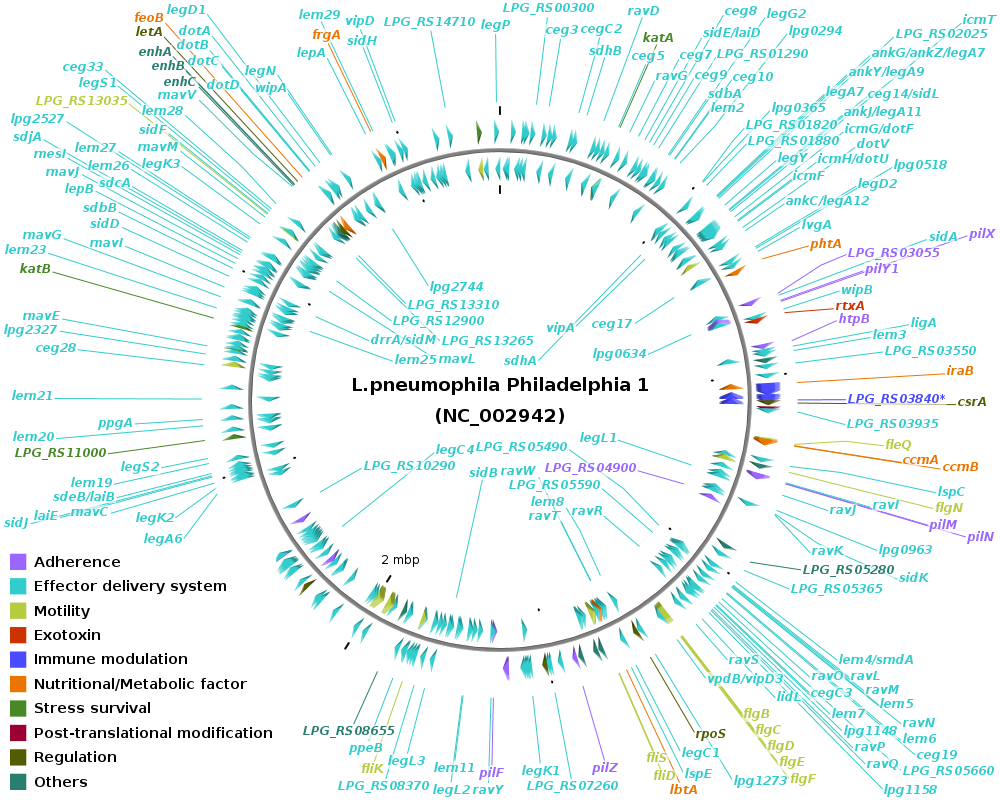
Genomic location of virulence-related genes in Legionella:
Reported anti-virulence compounds to Legionella:
 |
| Back to Top |
|