|
 
General information:
 A heterogeneous group of low-percentage G+C gram-positive aerobic bacteria which appear as chains under microscopic observation. A heterogeneous group of low-percentage G+C gram-positive aerobic bacteria which appear as chains under microscopic observation.
Divided into three groups by the type of hemolysis on blood agar: β-hemolytic (clear, complete lysis of red cells), α hemolytic (incomplete, green hemolysis), and γ hemolytic (no hemolysis). Lancefield classification is based on antigenic differences in cell wall carbohydrates (groups A to V).
More recently, Kawamura et al. divided the genus Streptococcus into six major groups based on their 16S rRNA sequences: i.e., the pyogenic, mitis, bovis, salivarius, anginosus, and mutants groups.
Surface carbohydrate antigens of S. pneumonia do not correspond to a specific Lancefield group, it can be considered a pyogenic (pus-producing) strain of Streptococcus.
S. pyogenes, the group A streptococcus (GAS), has been divided into over 150 distinct M types based on serological differences found in a surface protein known as the M protein (specified by the emm gene).
Group B Streptococcus (GBS), also referred to as S. agalactiae, can be divided into nine CPS serotypes (Ia Ib, II, III, IV, V, VI, VII and VIII) each antigenically and structurally unique.
Characteristics:
Horizontal gene transfer mediated by bacteriophages is perhaphs the most important phenomenon occurring in the GAS, where they have a major impact on pathogenicity as well as bacterial genome diversity and evolution. Phage-associated GAS virulence factors include SpeA, SpeC, SpeG, SpeH, SpeI, SpeJ, SpeK, SpeL, SpeM, MF2, MF3, MF4, Sla, Ssa, Sda, Sdn, as well as HylP.
Selected genomes: ⇒ comparative pathogenomics ⇐
S. agalactiae 2603V/R, 2160267 bp, NC_004116
S. agalactiae A909, 2127839 bp, NC_007432
S. agalactiae NEM316, 2211485 bp, NC_004368
S. dysgalactiae subsp. equisimilis GGS_124, 2106340 bp, NC_012891
S. equi subsp. equi 4047, 2253793 bp, NC_012471
S. equi subsp. zooepidemicus MGCS10565, 2024171 bp, NC_011134
S. gordonii str. Challis substr. CH1, 2196662 bp, NC_009785
S. mutans NN2025, 2013587 bp, NC_013928
S. mutans UA159, 2030921 bp, NC_004350
S. pneumoniae CGSP14, 2209198 bp, NC_010582
S. pneumoniae D39, 2046115 bp, NC_008533
S. pneumoniae Hungary19A-6, 2245615 bp, NC_010380
S. pneumoniae R6, 2038615 bp, NC_003098
S. pneumoniae Taiwan19F-14, 2112148 bp, NC_012469
S. pneumoniae TIGR4, 2160842 bp, NC_003028
S. pyogenes M1 GAS, 1852441 bp, NC_002737
S. pyogenes MGAS10270, 1928252 bp, NC_008022
S. pyogenes MGAS10394, 1899877 bp, NC_006086
S. pyogenes MGAS10750, 1937111 bp, NC_008024
S. pyogenes MGAS2096, 1860355 bp, NC_008023
S. pyogenes MGAS315, 1900521 bp, NC_004070
S. pyogenes MGAS5005, 1838554 bp, NC_007297
S. pyogenes MGAS6180, 1897573 bp, NC_007296
S. pyogenes MGAS8232, 1895017 bp, NC_003485
S. pyogenes MGAS9429, 1836467 bp, NC_008021
S. pyogenes SSI-1, 1894275 bp, NC_004606
S. pyogenes str. Manfredo, 1841271 bp, NC_009332
S. sanguinis SK36, 2388435 bp, NC_009009
S. suis 05ZYH33, 2096309 bp, NC_009442
S. suis 98HAH33, 2095698 bp, NC_009443
S. suis BM407, 2146229 bp, NC_012926
S. thermophilus CNRZ1066, 1796226 bp, NC_006449
S. thermophilus LMD-9, 1856368 bp, NC_008532
S. thermophilus LMG 18311, 1796846 bp, NC_006448
Genome-related publications:
 Ferretti JJ, et al., 2001. Complete genome sequence of an M1 strain of Streptococcus pyogenes Proc. Natl. Acad. Sci. USA. 98(8):4658-4663. Ferretti JJ, et al., 2001. Complete genome sequence of an M1 strain of Streptococcus pyogenes Proc. Natl. Acad. Sci. USA. 98(8):4658-4663.
Tettelin H, et al., 2001. Complete genome sequence of a virulent isolate of Streptococcus pneumoniae Science 293(5529):498-506.
Hoskins J, et al., 2001. Genome of the bacterium Streptococcus pneumoniae strain R6. J. Bacteriol. 183(19):5709-5717.
Smoot JC, et al., 2002. Genome sequence and comparative microarray analysis of serotype M18 group A Streptococcus strains associated with acute rheumatic fever outbreaks. Proc. Natl. Acad. Sci. USA. 99(7):4668-4673.
Beres SB, et al., 2002. Genome sequence of a serotype M3 strain of group A Streptococcus: phage-encoded toxins, the high-virulence phenotype, and clone emergence. Proc. Natl. Acad. Sci. USA. 99(15):10078-10083.
Tettelin H, et al., 2002. Complete genome sequence and comparative genomic analysis of an emerging human pathogen, serotype V Streptococcus agalactiae Proc. Natl. Acad. Sci. USA. 99(19):12391-12396.
Glaser P, et al., 2002. Genome sequence of Streptococcus agalactiae, a pathogen causing invasive neonatal disease. Mol. Microbiol. 45(6):1499-1513.
Ajdic D, et al., 2002. Genome sequence of Streptococcus mutans UA159, a cariogenic dental pathogen. Proc. Natl. Acad. Sci. USA. 99(22):14434-14439.
Nakagawa I, et al., 2003. Genome sequence of an M3 strain of Streptococcus pyogenes reveals a large-scale genomic rearrangement in invasive strains and new insights into phage evolution. Genome Res. 13(6):1042-1055.
Banks DJ, et al., 2004. Progress toward characterization of the group A Streptococcus metagenome: complete genome sequence of a macrolide-resistant serotype M6 strain. J. Infect. Dis. 190(4):727-738.
Bolotin A, et al., 2004. Complete sequence and comparative genome analysis of the dairy bacterium Streptococcus thermophilus. Nat Biotechnol 22(12):1554-1558.
Green NM, et al., 2005. Genome sequence of a serotype M28 strain of group a streptococcus: potential new insights into puerperal sepsis and bacterial disease specificity. J Infect Dis 192(5):760-770.
Sumby P, et al., 2005. Evolutionary origin and emergence of a highly successful clone of serotype M1 group a Streptococcus involved multiple horizontal gene transfer events. J Infect Dis 192(5):771-782.
Tettelin H, et al., 2005. Genome analysis of multiple pathogenic isolates of Streptococcus agalactiae: implications for the microbial "pan-genome". Proc Natl Acad Sci USA 102(39):13950-13955.
Beres SB, et al., 2006. Molecular genetic anatomy of inter- and intraserotype variation in the human bacterial pathogen group A Streptococcus. Proc Natl Acad Sci USA 103(18):7059-7064.
Holden MT, et al., 2007. Complete genome of acute rheumatic fever-associated serotype M5 Streptococcus pyogenes strain manfredo. J Bacteriol 189(4):1473-1477.
Makarova K, et al., 2006. Comparative genomics of the lactic acid bacteria. Proc Natl Acad Sci USA 103(42):15611-15616.
Lanie JA, et al., 2007. Genome sequence of Avery's virulent serotype 2 strain D39 of Streptococcus pneumoniae and comparison with that of unencapsulated laboratory strain R6. J Bacteriol 189(1):38-51.
Xu P, et al., 2007. Genome of the opportunistic pathogen Streptococcus sanguinis. J Bacteriol 189(8):3166-3175.
Chen C, et al., 2007. A Glimpse of Streptococcal Toxic Shock Syndrome from Comparative Genomics of S. suis 2 Chinese Isolates. PLoS ONE 2:e315.
Vickerman MM, et al., 2007. Genome-wide transcriptional changes in Streptococcus gordonii in response to competence signaling peptide. J Bacteriol 189(21):7799-7807.
Ding F, et al., 2009. Genome evolution driven by host adaptations results in a more virulent and antimicrobial-resistant Streptococcus pneumoniae serotype 14. BMC Genomics 10:158.
Disease:
GBS: neonatal meningitis, bacteria sepsis and pneumonia.
Major virulence factors in S. agalactiae:

Genomic location of virulence-related genes in S. agalactiae:
 |
Disease:
Pneumonia.
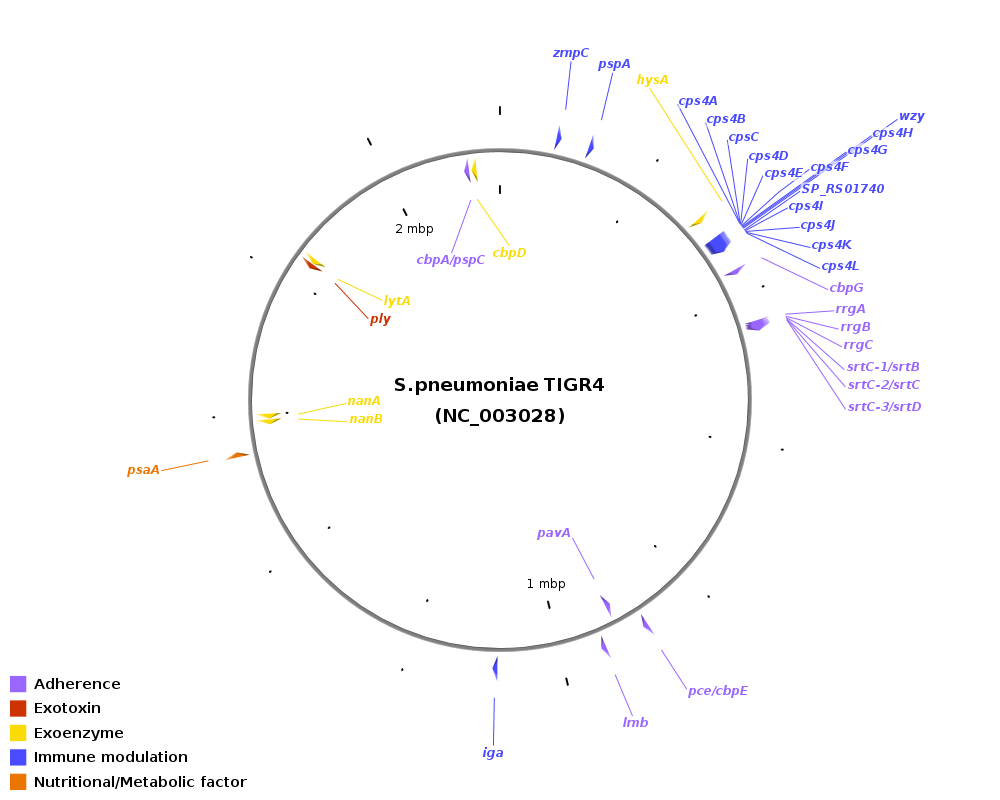
Major virulence factors in S. pneumoniae:

Genomic location of virulence-related genes in S. pneumoniae:
Disease:
GAS: responsible for a wide variety of disease, including pharyngitis, scarlet fever, impetigo, erysipelas, cellulitis, septicemia, toxic shock syndrome, necrotizing fasciitis and the sequelae, rheumatic fever and acute glomerulonephritis.
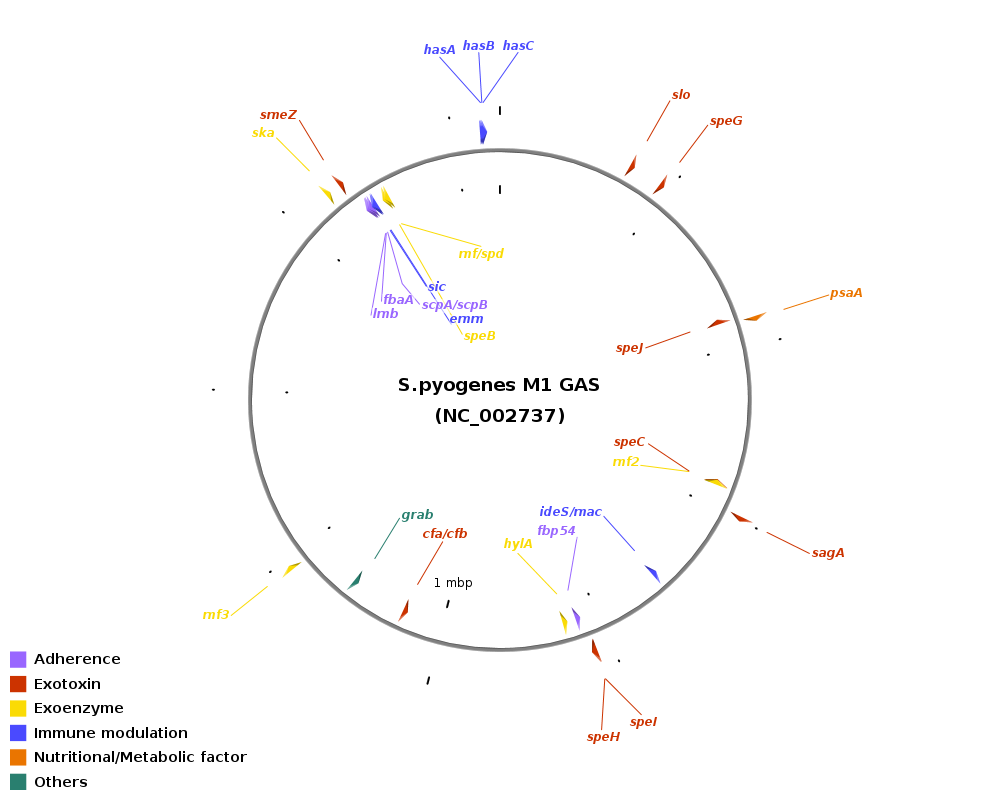
Major virulence factors in S. pyogenes:
Genomic location of virulence-related genes in S. pyogenes:
Reported anti-virulence compounds to Streptococcus:
 |
| Back to Top |
|